Introduction
The debate over the implementation of a Uniform Civil Code (UCC) in India has been a long-standing issue. The UCC is a proposal to replace personal laws based on religious traditions with a common set of laws that would apply equally to all citizens, regardless of their religion, ethnicity, or community. These personal laws govern areas such as marriage, divorce, inheritance, adoption, and maintenance. Presently, different communities in India follow their own set of personal laws — Hindu, Muslim, Christian, and others — making the legal system complex and varied.
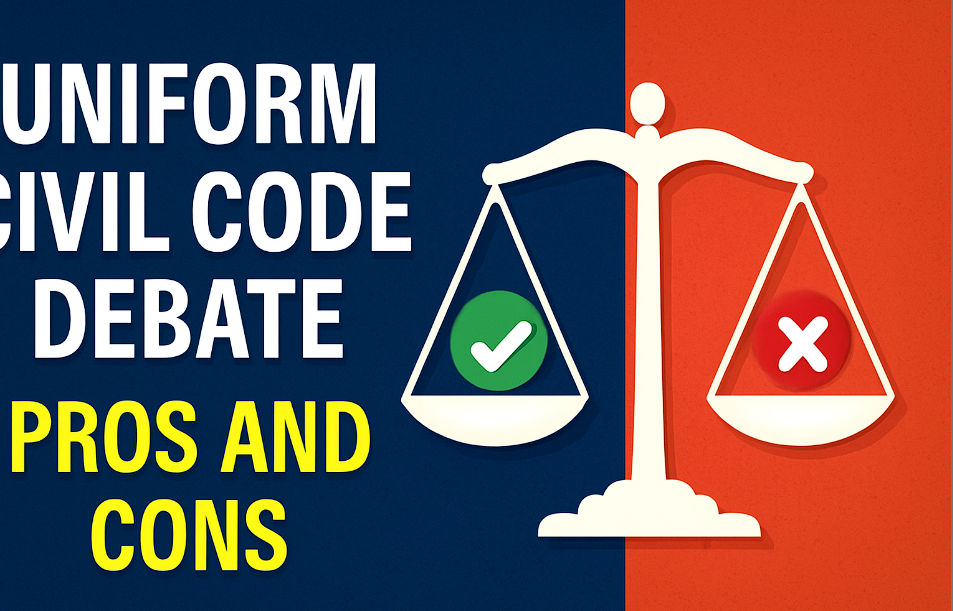
The debate surrounding the Uniform Civil Code centers on issues of equality, social justice, religious freedom, and the role of state intervention in personal matters. Supporters argue that the UCC would promote national integration and equality, while critics see it as an encroachment on religious freedom and community autonomy. In this article, we will explore the pros and cons of the Uniform Civil Code.
Pros of the Uniform Civil Code
- Equality Before the Law
One of the most significant arguments in favor of the UCC is that it promotes equality. Currently, different religious communities are governed by different personal laws. This creates discrepancies in the rights of individuals based on their religion. For example, the Hindu Marriage Act, 1955, and the Muslim Personal Law (Shariat) Application Act, 1937, differ significantly in areas such as inheritance and divorce. A UCC would ensure that all citizens are treated equally under the law, irrespective of their religious background. - Gender Equality
Personal laws of various religious communities often contain provisions that discriminate against women. For example, in many interpretations of Muslim law, polygamy is permissible, and women’s inheritance rights are less than those of men. Similarly, Hindu personal law historically discriminated against women in areas such as inheritance and property rights. The UCC can help promote gender equality by ensuring that all citizens, regardless of gender, have the same rights in areas such as marriage, divorce, inheritance, and adoption. - National Integration
India is a diverse country with multiple communities practicing different customs and traditions. This diversity, while a source of strength, can also lead to social divides. A UCC could be a unifying force, fostering a sense of national identity and integration. By adopting a common legal framework, citizens could be united under the same set of laws, which would help bridge the gaps between various religious and cultural groups. - Streamlined Legal System
The existence of multiple personal laws often leads to confusion and legal complexities. For example, cases related to inheritance or divorce may require a long and complicated legal process due to the multiplicity of personal laws. A uniform legal system would make the administration of justice more efficient and transparent, leading to quicker resolution of disputes. - Progressive Social Reforms
The UCC has the potential to bring about progressive reforms in areas where personal laws may be outdated or discriminatory. For example, laws that allow child marriage, polygamy, or discriminatory inheritance practices could be reformed under a UCC to ensure that they are in line with modern, progressive societal values and human rights standards.
Cons of the Uniform Civil Code
- Violation of Religious Freedom
One of the strongest arguments against the UCC is that it could violate religious freedom. In India, the Constitution guarantees the right to religious freedom under Article 25. Critics argue that the imposition of a common civil code would interfere with the personal laws of religious communities, which are considered an integral part of their faith and practices. The diversity of India’s religious communities means that each community has its own set of beliefs and customs, and enforcing a uniform legal framework could be seen as an infringement on the right to practice religion freely. - Cultural and Religious Identity
Personal laws are often deeply rooted in the cultural and religious traditions of a community. For many, these laws are more than just legal frameworks — they are symbolic of their identity and way of life. For instance, Muslim personal law governs not just the legal aspects of a Muslim’s life but also their religious practices and beliefs. Imposing a UCC could be seen as an attempt to erode these religious and cultural identities, leading to resistance from communities who view the laws as sacred and integral to their traditions. - Practical Challenges of Implementation
India is a vast and diverse country with multiple languages, religions, and cultures. Implementing a UCC would require careful consideration of these diverse needs and sensitivities. One of the main concerns is that a uniform code could be one-size-fits-all, without sufficiently accommodating the needs and practices of different communities. This could lead to dissatisfaction and even protests from communities that feel their customs and traditions are being undermined. - Political and Social Sensitivities
The issue of the UCC is politically sensitive, particularly in India’s pluralistic society. It has the potential to be used as a tool for political mobilization, with various political parties using it to appeal to their base. For example, the Bharatiya Janata Party (BJP) has long supported the idea of a UCC, while other parties, particularly those with Muslim support bases, have opposed it. The politicization of this issue could lead to divisions and tensions between communities and could make the implementation of the UCC more difficult. - Fear of Religious Intolerance
Critics argue that a Uniform Civil Code could lead to religious intolerance. They point out that the law could be used as a mechanism for imposing majority views on minority communities. For example, certain sections of the Hindu community might push for the UCC to reflect their customs and beliefs, which could undermine the rights and practices of other religious groups. This could lead to communal tensions and exacerbate divisions in society.
Conclusion
The debate on the Uniform Civil Code is an ongoing one, with passionate arguments on both sides. Proponents argue that a UCC is necessary for equality, gender justice, and national integration, while opponents caution that it could undermine religious freedoms, cultural identities, and social harmony. Ultimately, any decision on the UCC must be made with careful consideration of the diverse needs of India’s population and respect for its pluralistic fabric.
In an ideal scenario, the government would ensure that any move towards a Uniform Civil Code respects the diversity of India’s communities while also safeguarding the rights and freedoms of all citizens. While a UCC may be a step toward uniformity, the challenge lies in striking a balance between equality, freedom, and diversity.