
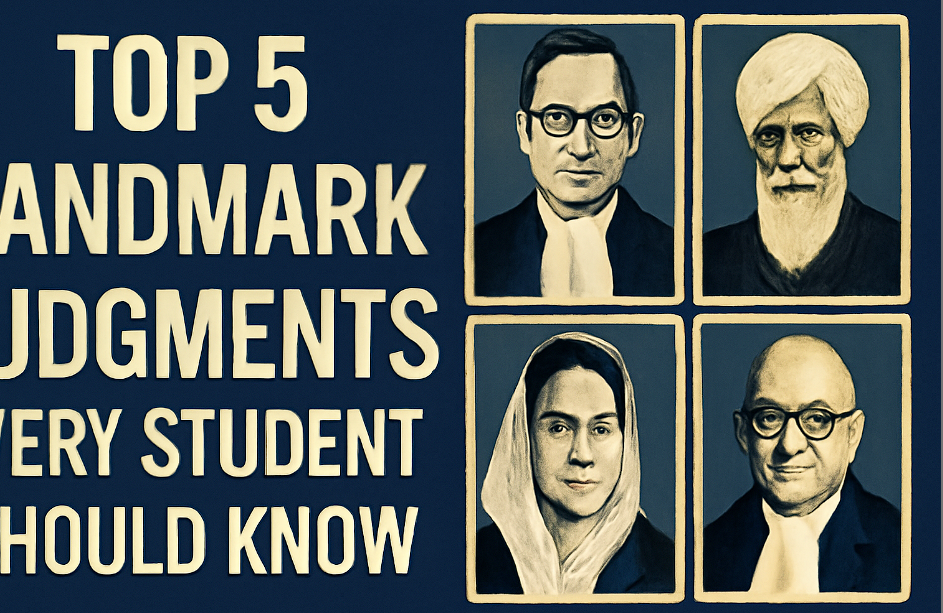
In the field of law, certain judgments have shaped the legal landscape of India and have had a profound impact on its judicial and legislative framework. These landmark rulings, delivered by the Supreme Court of India, have established critical legal precedents and interpretations that every law student should be familiar with. Below are five landmark judgments that are essential for understanding the evolution of Indian law.
1. Kesavananda Bharati v. State of Kerala (1973)
Case Overview:
The Kesavananda Bharati case is one of the most important decisions in Indian constitutional law. The Supreme Court of India, in this case, examined the limits of the Parliament’s power to amend the Constitution. The key issue was whether Parliament could amend any part of the Constitution, including the fundamental structure.
Judgment:
The Supreme Court held that while Parliament has the power to amend the Constitution, this power is not unlimited. The Court established the “Basic Structure Doctrine”, which states that certain fundamental features of the Constitution (such as democracy, the rule of law, and the separation of powers) cannot be amended by Parliament.
Significance:
- It introduced the Basic Structure Doctrine, which acts as a safeguard to protect the core values of the Constitution from being altered by the legislature.
- It reinforced the supremacy of the Constitution and preserved its fundamental principles.
2. Maneka Gandhi v. Union of India (1978)
Case Overview:
The Maneka Gandhi case addressed the issue of right to personal liberty under Article 21 of the Indian Constitution, especially in relation to freedom of speech and expression and the procedure established by law.
Judgment:
The Supreme Court expanded the interpretation of Article 21 (Right to Life and Personal Liberty). The Court held that personal liberty cannot be taken away except according to a just, fair, and reasonable procedure. The Court also held that the term “procedure established by law” under Article 21 is not restricted to just any law, but must be a procedure that is reasonable, fair, and just.
Significance:
- The judgment broadened the scope of fundamental rights in India.
- It laid down the principle that due process of law must be followed when depriving a person of their liberty.
- It also reaffirmed the significance of fundamental rights in Indian democracy.
3. Indira Gandhi v. Raj Narain (1975)
Case Overview:
This case arose out of a petition challenging the election of Indira Gandhi, the then Prime Minister of India. Raj Narain, her opponent in the 1971 general elections, alleged electoral malpractices.
Judgment:
The Supreme Court ruled that Indira Gandhi’s election was invalid due to the violation of electoral laws. The Court also declared that Article 329 of the Constitution provides a special protection to elections but does not bar judicial review of election-related matters. The judgment led to a political crisis, resulting in Indira Gandhi declaring the Emergency in India (1975-1977).
Significance:
- This ruling reaffirmed the rule of law and the principle of free and fair elections in India.
- It also clarified that no one, including the Prime Minister, is above the law.
- It marked a key moment in the evolution of democracy in India.
4. Shah Bano Case (1985)
Case Overview:
In the Shah Bano case, a Muslim woman named Shah Bano filed a petition for maintenance under Section 125 of the Criminal Procedure Code (CrPC) after being divorced by her husband, who refused to pay maintenance.
Judgment:
The Supreme Court ruled in favor of Shah Bano, granting her maintenance under Section 125 CrPC, even though she was a Muslim woman, and the personal laws of Muslims did not require her husband to provide maintenance after divorce. The Court held that Section 125 applies to all citizens, regardless of their religion, and personal laws cannot override the secular provisions of the Constitution.
Significance:
- The judgment highlighted the need for uniform civil law in India.
- It reinforced the idea that the secular and non-discriminatory provisions of the Indian Constitution should apply to all citizens.
- The ruling led to political debates and was followed by the Muslim Women (Protection of Rights on Divorce) Act, 1986, which sought to protect Muslim women’s rights in accordance with Islamic law.
5. Nandini Satpathy v. P.L. Dani (1978)
Case Overview:
The Nandini Satpathy case was a landmark decision on the right against self-incrimination under Article 20(3) of the Indian Constitution. It arose when Nandini Satpathy, a former Chief Minister of Orissa, was summoned for questioning by the Central Bureau of Investigation (CBI).
Judgment:
The Supreme Court held that a person has the right against self-incrimination, which means that no one can be compelled to give evidence against themselves. The Court also emphasized that the right to silence is implicit in Article 20(3).
Significance:
- It reinforced the principle of right against self-incrimination under Article 20(3).
- The judgment clarified that forced confessions during interrogation are not permissible in India and cannot be used as evidence in court.
Conclusion
These landmark judgments have shaped the Indian legal landscape by safeguarding fundamental rights, ensuring accountability, and strengthening the rule of law in the country. As a law student, understanding these cases is crucial for grasping the core principles of constitutional law, criminal law, family law, and human rights. These judgments not only reflect the evolving nature of Indian jurisprudence but also provide insights into the Indian judiciary’s role in interpreting and upholding the Constitution.
Each of these rulings contributes to the legal framework that governs Indian society today and is essential for every law student to study in order to develop a well-rounded understanding of the law and its application.