Introduction
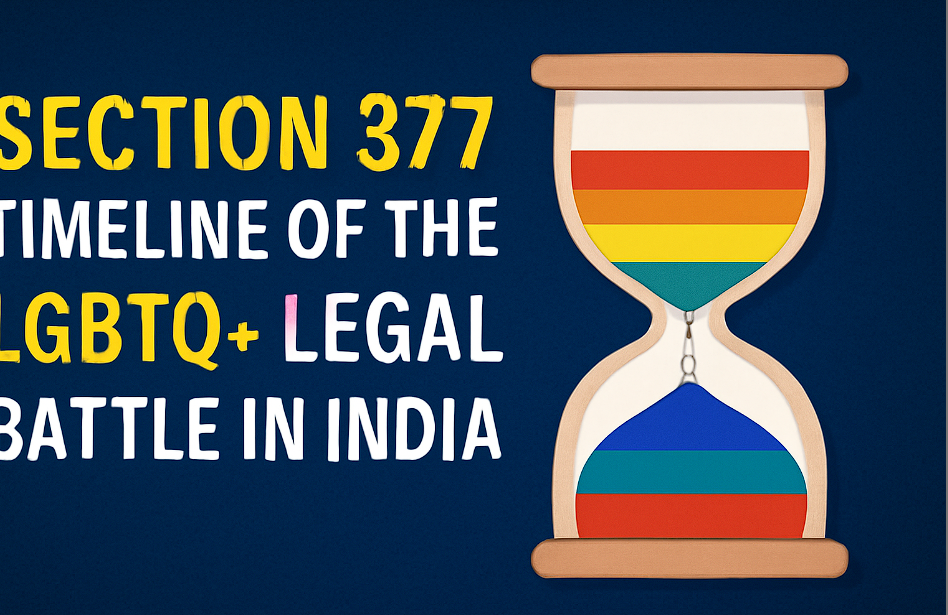
Section 377 of the Indian Penal Code (IPC) was one of the most controversial laws in India, criminalizing consensual sexual activity between same-sex adults. It was a colonial-era law introduced by the British in 1860 and remained in force for more than a century and a half, negatively impacting the LGBTQ+ community in India. This article delves into the timeline of the LGBTQ+ legal battle in India, focusing on the key events and landmark judgments that led to the eventual decriminalization of same-sex relationships in India.
The Colonial Roots: 1860-1947
The roots of Section 377 lie in British colonial rule. The Indian Penal Code, drafted by Lord Macaulay, included this section, which criminalized “unnatural offenses.” It was based on Victorian-era morality, defining “unnatural offenses” as “carnal intercourse against the order of nature.” This vague term was interpreted to include same-sex relations, among other sexual practices.
For over a century, this law was largely ignored in the public sphere. However, it was occasionally used in cases involving sexual abuse or exploitation, but it did not see widespread application. During the period of colonialism, homosexuality was viewed as a “Western vice,” and the law became one of the tools used to control personal freedoms and dictate moral behavior.
Post-Independence Period: 1947-2001
After India gained independence in 1947, Section 377 continued to exist in the Indian Penal Code without any significant challenge. The new independent government did not prioritize the reform of this law, and it remained a legacy of colonial rule. While there was some conversation around issues like morality, sexuality, and individual freedoms in post-independence India, there was no formal push to challenge or amend Section 377 until the 21st century.
Early Calls for Reform: 2001-2009
2001: The First Legal Challenge
The first significant legal challenge to Section 377 came in 2001, when the Naz Foundation, a Delhi-based non-governmental organization working on HIV/AIDS and sexual health, filed a petition in the Delhi High Court. The petition argued that Section 377 was discriminatory and violated fundamental rights guaranteed by the Indian Constitution, particularly the right to equality (Article 14), the right to freedom of speech and expression (Article 19), and the right to life and personal liberty (Article 21).
The Naz Foundation’s petition emphasized that the law contributed to the stigmatization of the LGBTQ+ community, making it difficult for individuals to seek medical help and counseling without fear of legal consequences. This petition marked the beginning of an organized legal struggle for the rights of the LGBTQ+ community in India.
2004: The Delhi High Court’s First Response
In 2004, the Delhi High Court referred the case to a larger bench, signaling the significance of the issue. However, the case took a long time to reach the final hearing. It was not until 2009 that the High Court finally gave its verdict.
2009: Delhi High Court’s Landmark Judgment
On July 2, 2009, the Delhi High Court delivered a landmark ruling in the case of Naz Foundation v. Government of NCT of Delhi, striking down Section 377 to the extent that it criminalized consensual same-sex acts between adults. The court ruled that the law violated the right to privacy and equality under the Indian Constitution, and it was considered unconstitutional in the case of consensual, adult, same-sex relationships.
The court observed that Section 377 had “no legitimate aim,” and its continuation led to the violation of the fundamental rights of the LGBTQ+ community. The judgment celebrated the dignity and autonomy of individuals, stating that the law discriminated against a “minuscule” section of society.
This judgment was a historic victory for the LGBTQ+ community in India and a significant step toward recognizing the rights and dignity of sexual minorities. However, the joy was short-lived.
The Setback: 2013 Supreme Court Ruling
2012: The Appeal
Despite the 2009 ruling, the battle was far from over. In December 2012, the Supreme Court of India took up an appeal filed by various religious groups and the government against the Delhi High Court’s verdict. These groups argued that the decision to decriminalize homosexuality should be a matter for the legislature, not the judiciary, and that it went against the traditional moral fabric of Indian society.
2013: Supreme Court Reverses the Delhi High Court’s Decision
On December 11, 2013, the Supreme Court of India delivered a controversial judgment in Suresh Kumar Koushal v. Naz Foundation, reversing the Delhi High Court’s 2009 verdict and reinstating Section 377 in its entirety. The court ruled that it was up to the legislature, not the judiciary, to decide whether to amend or repeal the law.
The ruling came as a blow to the LGBTQ+ community and their allies, and it was met with widespread protests both within India and abroad. Activists condemned the judgment as a setback in the fight for equality and human rights. However, despite this setback, the legal battle was far from over.
The Final Victory: 2018 Supreme Court Judgment
2016: The Curative Petition
In the years following the 2013 ruling, activists and legal professionals did not give up on challenging Section 377. In 2016, a curative petition was filed in the Supreme Court, urging the Court to reconsider its 2013 decision. The petition argued that the earlier verdict violated the fundamental rights of LGBTQ+ individuals and contradicted the principles of justice and equality.
As the debate gained momentum, the legal and public discourse on LGBTQ+ rights grew more supportive, and there was increasing pressure for the court to reconsider its position.
2017: The Beginning of Reconsideration
In 2017, the Supreme Court, in a different case (K.S. Puttaswamy v. Union of India), ruled that the right to privacy was a fundamental right under the Indian Constitution. This opened the door to revisiting Section 377, as privacy was a central issue in the original case. In response, the Chief Justice of India announced that the Supreme Court would revisit Section 377, signaling a shift in judicial approach.
2018: The Historic Judgment
Finally, on September 6, 2018, the Supreme Court of India delivered a historic verdict in the case of Navtej Singh Johar v. Union of India. In this unanimous judgment, the court decriminalized consensual same-sex sexual relations between adults, effectively reading down Section 377. The Court ruled that Section 377, insofar as it criminalized consensual same-sex relations, was unconstitutional.
The Supreme Court declared that the law was discriminatory and violated the right to equality and privacy under the Indian Constitution. The judgment recognized the dignity of LGBTQ+ persons, stating that they should not be treated as second-class citizens. The decision was widely celebrated as a monumental victory for LGBTQ+ rights in India, and it was hailed as a step toward greater inclusivity and acceptance.
Justice Indu Malhotra, in her concurring opinion, noted that LGBTQ+ persons had the right to love and live with dignity and that the law had been used as a tool for social exclusion and harassment. The judgment marked a transformative moment in India’s legal landscape, aligning it with global movements toward LGBTQ+ rights.
The Aftermath and Current Status
Following the 2018 ruling, Section 377 was effectively nullified as it pertains to consensual same-sex relations. However, challenges remain in the journey toward full equality. The Supreme Court’s ruling was a significant milestone, but there are still issues such as marriage equality, adoption rights, and societal discrimination that the LGBTQ+ community faces.
In the aftermath of the ruling, the Indian government and lawmakers have remained largely silent on the issue of marriage equality, leaving this matter unresolved. Activists continue to press for further legal reforms to ensure full equality for LGBTQ+ individuals, including the recognition of same-sex marriages and inheritance rights.
Conclusion
The legal battle over Section 377 was one of the most important civil rights struggles in India. It spanned over two decades, culminating in a landmark Supreme Court ruling in 2018 that decriminalized consensual same-sex relationships. This legal victory was the result of tireless efforts by activists, NGOs, and the LGBTQ+ community, and it represents a significant step toward equality and justice for sexual minorities in India.
While the decriminalization of Section 377 is a historic victory, the struggle for LGBTQ+ rights is far from over. As the fight for equal rights continues, it is essential to recognize the progress made and continue pushing for a more inclusive and just society.