
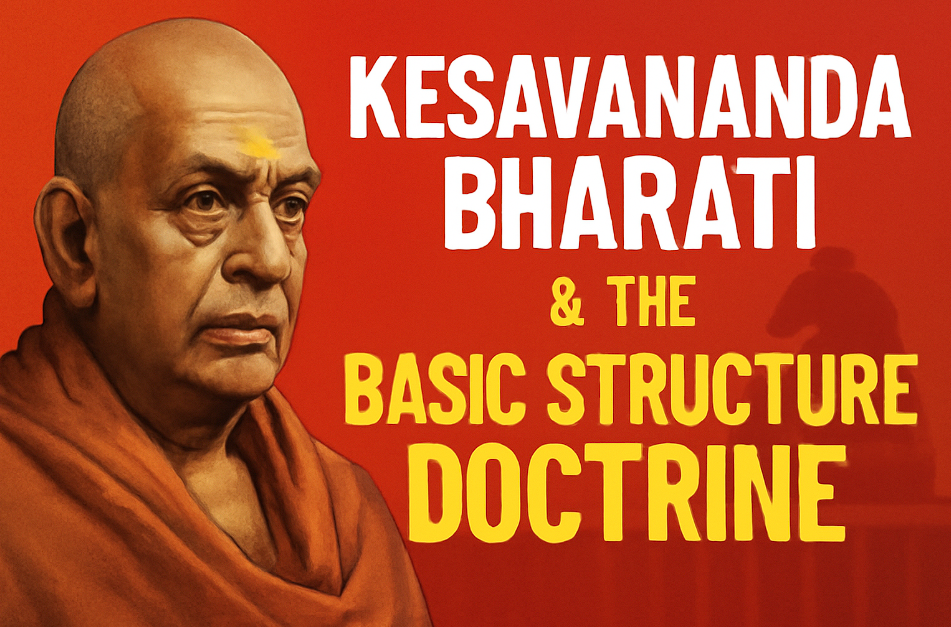
The Kesavananda Bharati v. State of Kerala (1973) case is one of the most significant judgments in the history of Indian constitutional law. The case is especially important for its introduction of the Basic Structure Doctrine, a legal principle that continues to shape India’s constitutional framework. This doctrine has had a profound impact on how the Indian Constitution is interpreted and has been crucial in maintaining the supremacy of the Constitution.
In this article, we will explore the Kesavananda Bharati case and its far-reaching implications, especially the Basic Structure Doctrine.
1. Background of the Case
The case arose when Kesavananda Bharati, a religious leader and the head of a religious institution in Kerala, challenged the Kerala government’s attempt to enforce the Kerala Land Reforms Act, which sought to limit the amount of land that could be owned by individuals and religious institutions. The law aimed to redistribute land to the poor and landless.
Kesavananda Bharati argued that the Kerala Land Reforms Act violated his fundamental rights under Article 19(1)(f), which guarantees the right to acquire, hold, and dispose of property. The matter eventually reached the Supreme Court of India.
However, the case was not only about land reforms; it became a landmark constitutional case because it raised a crucial question: Can Parliament amend the Constitution, including its fundamental provisions, and if so, to what extent?
2. The Issue at Hand
The central issue in the case was whether the Parliament had the power to amend any part of the Constitution, including its fundamental rights. Prior to the case, the Supreme Court had interpreted the power of Parliament to amend the Constitution under Article 368, but the scope of that power was not fully clear.
The case was heard by a 13-judge bench, which was convened to address the constitutional questions raised by the case. The Court was required to decide on two important aspects:
- Whether Parliament could amend the fundamental rights under Part III of the Constitution.
- Whether the power to amend the Constitution was subject to any limitations.
3. The Judgment
The Supreme Court delivered a divided verdict in the Kesavananda Bharati case. The Court upheld the power of Parliament to amend the Constitution, but it also ruled that this power is not unlimited. The Court held that Parliament cannot amend or alter the Constitution in a way that would alter or destroy its “basic structure.”
In a majority opinion, the Court ruled that certain fundamental features of the Constitution are so intrinsic to the Constitution’s identity that they cannot be altered by a constitutional amendment. These features are considered to form the “basic structure” of the Constitution.
4. The Basic Structure Doctrine
The Basic Structure Doctrine was introduced by the Kesavananda Bharati case as a way of ensuring that the fundamental principles of the Indian Constitution remain intact, even in the face of amendments.
The doctrine essentially holds that while Parliament has the power to amend the Constitution, it cannot alter or destroy the basic features of the Constitution through amendments. Some elements of the Constitution, which form its basic structure, are beyond the power of the Parliament to amend.
Although the Supreme Court did not provide a definitive list of what constitutes the basic structure, it did suggest several features, such as:
- Democracy
- Rule of law
- Separation of powers
- Judicial review
- Federalism
- Secularism
- Individual liberty and equality
These features, according to the Court, are intrinsic to the Constitution and cannot be changed by ordinary legislative processes.
5. Impact of the Basic Structure Doctrine
The introduction of the Basic Structure Doctrine has had a profound impact on constitutional law in India. It has served as a safeguard against potential abuse of power by the Parliament and ensured that fundamental rights and principles enshrined in the Constitution remain protected.
Judicial Review and Constitutional Supremacy
The Basic Structure Doctrine has strengthened the role of the judiciary in protecting constitutional values. The Court can now review laws and amendments to ensure that they do not violate the basic structure of the Constitution. This has reinforced the idea that the Constitution is a living document and cannot be subjected to arbitrary amendments by a simple majority in Parliament.
Limits on Parliament’s Power
Prior to Kesavananda Bharati, there was debate over whether Parliament had the absolute power to amend the Constitution, including the Fundamental Rights. The Basic Structure Doctrine limits this power by asserting that there are certain core principles that Parliament cannot alter. This principle upholds the supremacy of the Constitution and ensures that it remains a document that guarantees democracy, justice, and fundamental rights for all citizens.
Influence on Subsequent Cases
The Kesavananda Bharati ruling has been cited in numerous landmark cases that have involved constitutional amendments and the relationship between fundamental rights and other provisions. Some of the key cases that have referred to the Basic Structure Doctrine include:
- Minerva Mills Ltd. v. Union of India (1980): The Supreme Court further emphasized the supremacy of fundamental rights over the Directive Principles of State Policy, affirming the Basic Structure Doctrine.
- Indira Gandhi v. Raj Narain (1975): The Court reaffirmed that no part of the Constitution, including electoral laws, can be amended if it alters the basic structure.
- L. Chandra Kumar v. Union of India (1997): This case involved the judicial review of laws related to administrative tribunals, reaffirming the supremacy of the judiciary in protecting constitutional principles.
6. Conclusion
The Kesavananda Bharati case and the Basic Structure Doctrine are central to understanding the evolution of constitutional law in India. The doctrine ensures that while Parliament can make amendments to the Constitution, it cannot alter its core principles. This case not only protected the integrity of India’s democratic structure but also empowered the judiciary to play a more active role in defending the Constitution.
For law students, understanding the Kesavananda Bharati case is essential because it addresses fundamental questions about the balance of power between the legislature and the judiciary and underscores the supremacy of the Constitution. The Basic Structure Doctrine remains a cornerstone of Indian constitutional law, shaping the way laws are made, amended, and interpreted in India.